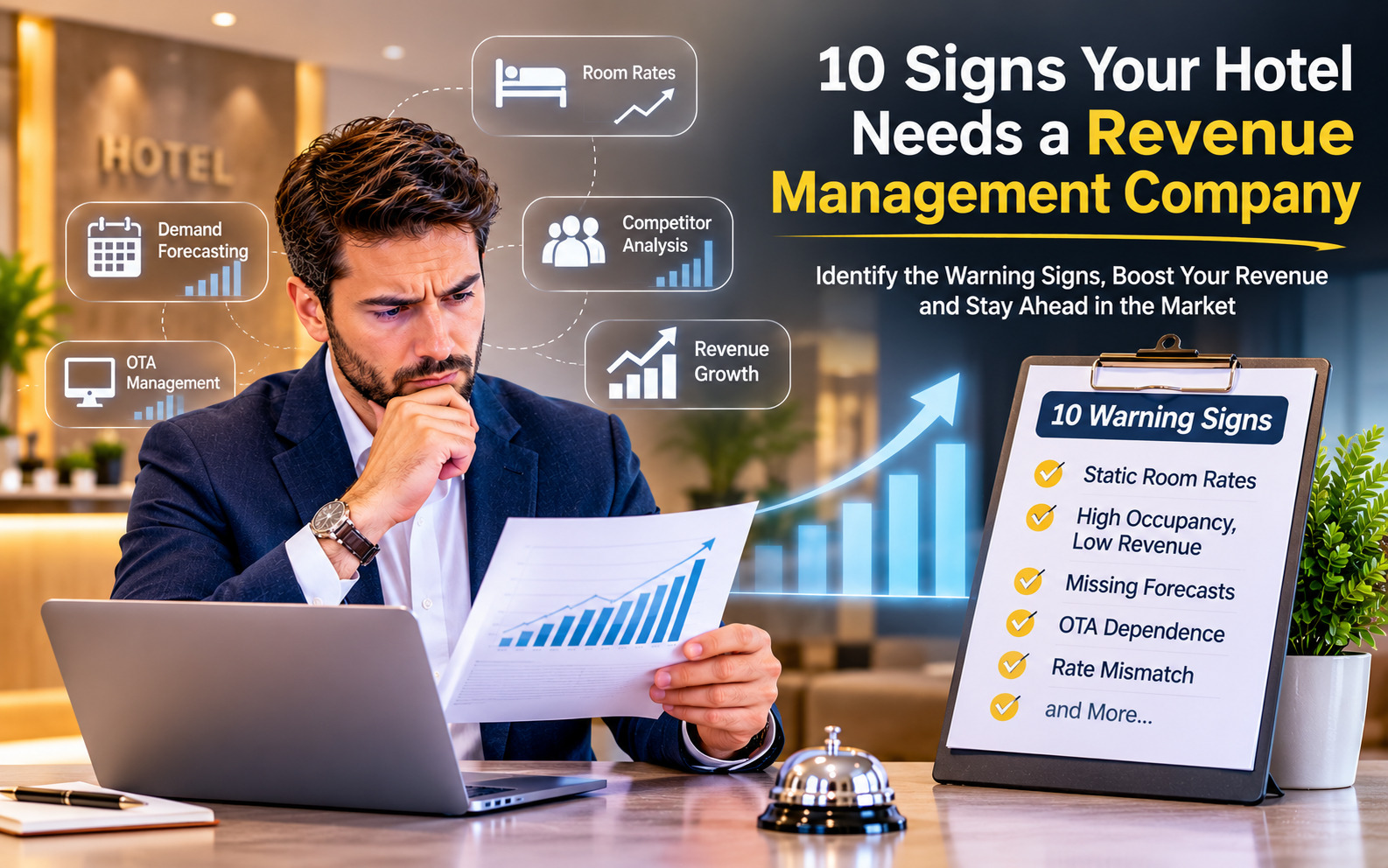
Your hotel needs a revenue management company when room rates, OTA listings and demand forecasts are handled on gut feel, squeezed into someone's spare time, or not handled at all, and the gap is starting to show in your monthly numbers. A revenue management company is an outside team that sets your room rates, manages your online channels and forecasts demand, so each room sells at the best price the market will pay on that date.
Most owners only notice the problem when a month closes below target. By then that revenue is gone for good, because an empty room cannot be sold later.
In this guide you will find the 10 warning signs we see most often in independent hotels, a quick test for each one, what ignoring it really costs, and a simple self-score that tells you whether to fix things in-house or call in experts.
What Does a Revenue Management Company Do?
Before the signs, it helps to be clear about the job. A revenue management company takes ownership of the decisions that decide how much money each room makes. In practice that covers five areas:
-
Pricing. Setting and changing rates every day based on demand, not on a rate card printed at the start of the season. If you want the mechanics, our guide to dynamic pricing for hotels explains how daily rates are set.
-
Forecasting. Reading booking pace (pickup), past data and the local events calendar to predict busy and quiet dates weeks ahead.
-
Distribution. Managing how your hotel appears and sells on OTAs such as Booking.com, MakeMyTrip and Agoda, and on your own website.
-
Competitor intelligence. Watching a set of comparable hotels so your rate is positioned on purpose, not by accident.
-
Reporting and action. Turning occupancy, ADR (average daily rate) and RevPAR (revenue per available room) into clear decisions every week.
This is different from a hotel management company, which runs your whole operation, staff included. It is also different from revenue management software, which recommends prices but still needs someone to check, decide and act. A good revenue management company in India works as your remote revenue team: it makes the calls, executes them on your channels and reports back.
If you are new to the subject, start with our simple guide to hotel revenue management. If you already know the basics, read on and count how many of the following signs feel familiar.
Sign 1: Your Room Rates Have Not Moved in Weeks
Open your channel manager or extranet and look at the rate for a standard room across the next 60 days. If you see the same number repeated date after date, with maybe a weekend bump, you have a static pricing problem.
Static rates feel safe. They are easy to explain to the front desk and nobody gets a call from an angry guest. But demand is never flat. A Tuesday in a quiet month and a Saturday during a wedding rush are not worth the same, and a single rate treats them as if they were.
How to spot it
-
You change rates fewer than four times a month.
-
Your rates are set by season (peak, shoulder, off) and then left alone.
-
You raise prices only when a staff member says "we are almost full".
-
Your Best Available Rate (BAR) has not been reviewed since the last tariff card was printed.
What it is costing you
Static pricing loses money in two directions at once. On high-demand dates you sell rooms too cheaply, and guests who would have paid more get a bargain. On low-demand dates your rate is too high for the market, so the room stays empty while a competitor with a sharper price fills theirs. You never see either loss in your accounts, because missed revenue does not show up as a line item. It simply never arrives.
Try this before you call anyone
Pick your next three Saturdays and your next three Tuesdays. For each date, note how many rooms are already booked. If the Saturdays are filling much faster at the same rate, that is the market telling you the rate is too low. Raise those dates by a small step and watch whether bookings slow. Doing this once is easy. Doing it for every date, every day, is where most owners run out of time, and that is the point where an expert team earns its fee.
Sign 2: You Sell Out, Yet Still Miss Your Revenue Target
This one confuses many owners. The hotel looks busy, the team is stretched, the car park is full, and still the month ends short. High occupancy with weak revenue is one of the clearest signs that pricing, not demand, is your problem.
How to spot it
-
You regularly reach 100% occupancy two or three weeks before the date.
-
Your occupancy rises year on year, but your ADR stays flat or falls.
-
Last-minute callers are turned away on dates you sold out early.
-
Your RevPAR (room revenue divided by total available rooms) is growing more slowly than your occupancy.
What it is costing you
Selling out early means you filled the hotel at a price the market considered cheap. The guests who would have booked at a higher rate in the final week had nowhere to stay with you. Think of it as giving away the most valuable inventory you have, the last few rooms on your busiest nights.
There is a hidden operational cost too. Full rooms mean more housekeeping, more laundry, more amenities and more wear on your property. If those rooms are sold at a low rate, your profit per room shrinks even as your workload grows.
The question to ask yourself
Would you rather be 100% full at a low rate or 90% full at a much better one? The answer depends on your costs, but most independent hotels never actually run the numbers. A revenue team does this every day with a simple tool: pickup analysis. It tracks how fast each future date is filling. When a date fills faster than normal, the rate goes up in steps. When it lags, the team looks at promotions, packages or channel visibility.
Try this before you call anyone
Look at the last date you sold out. Check when the last room was booked. If it was more than 10 days before arrival, your rate on that date was almost certainly too low. Next time, set a rule: once a date passes 70% occupancy with more than two weeks to go, increase the rate by a fixed step and review it again in 48 hours.
Sign 3: You Hear About Busy Dates After Your Competitors Do
A cricket match, a large wedding, a religious festival, a trade fair or a long weekend can change demand in your city overnight. If you usually learn about these dates from a guest or a staff member, and your neighbours have already raised their rates, you are missing one of the core jobs of revenue management: forecasting.
How to spot it
-
You have no written events calendar for the next 12 months.
-
Your rates on festival and long-weekend dates look like normal-week rates.
-
You realise a date was busy only after it sold out.
-
Your forecast, if you have one, is last year's numbers with a guess added.
Why it matters more every year
Travel inside India keeps growing, and growth brings more peaks to manage. According to the Ministry of Tourism, India recorded 2,948.19 million domestic tourist visits in 2024, a 17.51% increase over 2023. More travellers means more dates where demand spikes, and more money left on the table for hotels that price those dates like any other day.
Demand also does not arrive evenly. Pilgrimage towns, hill stations, beach destinations and business cities all have their own calendars. A long weekend means a rush in Lonavala or Goa but can mean a quiet weekend for a business hotel in Andheri. Generic advice will not cover this. Your forecast needs to be local.
What a revenue team does differently
A revenue team builds a 12-month demand calendar for your exact location: public holidays, school breaks, festivals, wedding dates, exhibitions and local events. It then watches booking pace against that calendar every day and moves rates before demand peaks, not after.
Try this before you call anyone
Spend one hour listing every holiday, festival, exam break and major local event for the next six months. Mark each one high, medium or low demand. Then check your current rates on those dates. Any high-demand date priced like a normal day is an easy first fix.
Sign 4: One or Two OTAs Bring In Almost All Your Bookings
OTAs are powerful. They give a small hotel the same shop window as a large chain. The trouble starts when one or two of them become your whole business.
How to spot it
-
More than three quarters of your room nights come from one or two OTAs.
-
Your own website gets very few direct bookings, or has no booking engine at all.
-
A drop in your OTA ranking leads straight to a drop in revenue.
-
Your OTA listing has missing photos, outdated descriptions, or wrong room types.
-
You are not sure which OTA promotions, programmes or visibility tools you have switched on.
What it is costing you
Every OTA booking carries a commission, so heavy dependence quietly lowers your net rate on every room. It also hands control to someone else. If an OTA changes its ranking rules, its commission terms or its promotions, your revenue moves with it and you can do very little in the short term.
Weak listings make it worse. A listing with poor photos, thin content or wrong policies ranks lower, converts fewer lookers into bookers, and forces you to discount to stay visible. This is where an experienced OTA management company makes a quick difference. It cleans up listings, picks the right promotions, monitors ranking and pushes for a healthier channel mix over time.
A healthier channel mix
The goal is not to leave the OTAs. They will likely stay important for most independent hotels. The goal is balance: strong, well-ranked OTA listings, plus a direct booking path through your own website and repeat guests, so no single channel can hurt you badly. Our OTA listing and onboarding service covers the setup side, and our hotel technology guide explains how a booking engine and channel manager support direct sales.
Try this before you call anyone
Export last quarter's bookings by source. Work out the share of room nights and the net revenue (after commission) for each channel. If one channel dominates both, write down two actions for this month: one to improve that listing's quality, and one to grow a second channel.
Sign 5: Your Rates Do Not Match Across Channels
Search for your hotel on two or three OTAs and on your own website for the same date. If the prices differ, and you did not plan it that way, you have a rate parity problem.
How to spot it
-
The same room shows different prices on different OTAs.
-
Your own website is more expensive than an OTA, which pushes guests to book through the OTA.
-
You get overbookings because inventory did not update on one channel.
-
You change rates in one extranet and forget the others.
-
An OTA has sent you a parity warning or lowered your visibility.
Why it matters
Rate mismatches hurt you in three ways. First, guests notice. Price comparison is normal now, and a guest who finds a lower price elsewhere loses trust in your direct channel. Second, OTAs may react by reducing your visibility, which costs bookings you never see. Third, mismatches often come from manual updates, and manual updates also cause overbookings, the most stressful problem a front desk can face.
The real root cause
Parity problems are rarely about intent. They usually come from rates being changed by hand across several extranets, from a channel manager that is not set up properly, or from promotions applied on one channel but not on others. Fixing the symptom (one wrong price) without fixing the process means it will happen again next week.
A revenue team sets a single source of truth for rates, usually through a properly mapped channel manager, and checks parity on a fixed schedule. It also plans any deliberate differences, such as member rates or package rates, so they are intentional and within OTA rules.
Try this before you call anyone
Do a parity check every Monday for 30 days. Pick five future dates and record the price on each channel, including your website. Every mismatch you find, trace back to its cause: a manual update, a mapping error or a promotion. If most causes are manual, your next investment should be process and technology, not more checking.
Sign 6: Nobody on Your Team Actually Owns Revenue
Ask your team a simple question: "Who decided today's room rate?" If the answer is "the owner, when he gets time", "the front office manager, after the shift" or "nobody, it is the same as last week", revenue has no owner.
How to spot it
-
Pricing is done after hours or on weekends by someone with another full-time job.
-
When that person is sick or on leave, rates simply do not change.
-
No one has a weekly target for ADR, RevPAR or channel mix.
-
Your general manager spends more time on guest complaints and staffing than on revenue.
What it is costing you
Revenue management is a daily job. Rates, pickup, competitor moves and OTA rankings change every day. When it is a side task, it gets done when there is time, which in a busy hotel means rarely and in a hurry. Decisions get pushed until something goes wrong, and by then the opportunity has passed.
There is also a skills gap. Running a front desk or a kitchen well is a very different skill from reading booking curves and pricing for future demand. Expecting one person to be great at all of it is unfair to them and expensive for you.
Your three options
You can hire a full-time revenue manager, use software and train someone to run it, or bring in a hotel revenue management company that acts as your remote revenue team. Each has trade-offs in cost, coverage and control, and we compare them in detail in outsourced revenue management vs an in-house revenue manager. For most independent hotels with fewer than 60 rooms, a full-time hire is hard to justify, which is why outsourcing is so common in this segment.
Try this before you call anyone
For one week, ask whoever handles pricing to log every rate change and the reason for it. If the log is nearly empty, or the reasons are "same as last year" and "felt busy", you have your answer.
Sign 7: You Price Without Watching a Competitor Set
Every guest compares. They look at your hotel next to three or four similar options on the same screen. If you do not know what those hotels are charging for the same dates, you are pricing blind.
How to spot it
-
You cannot name the four to six hotels your guests most often compare you with.
-
You check competitor prices only occasionally, often just for tonight.
-
Your pricing rule is "match the cheapest nearby hotel".
-
You do not know where your review score and ranking sit against those hotels.
Why "match the cheapest" is a trap
Copying the lowest price in town feels competitive, but it hands your pricing decisions to the hotel with the weakest strategy. If your property has better reviews, a better location or better rooms, you can usually charge more and still win the booking. If it does not, the answer is often to improve the listing or the offer, not to keep cutting price.
A competitor set, or compset, solves this. It is a short list of hotels that compete for the same guests: similar location, star level, room type and review score. A revenue team tracks their rates for every future date, not only tonight, so you can see who is filling up and who is discounting before it hits your bookings.
Positioning on purpose
With a compset in place, your rate stops being a guess. You decide where to sit: slightly above the set because of your reviews, level with it on weekdays, or below it to win a specific segment. Then you hold that position consistently. This is the difference between pricing and reacting.
Try this before you call anyone
Choose five competitor hotels. For the next 14 nights, record their lowest public rate and their review score on one OTA, alongside yours. Even this small table will show whether you are cheaper than hotels with weaker reviews, which is the most common and most fixable pricing gap we see.
Sign 8: Your Reports Tell You What Happened, Not What to Do
Many hotels already have plenty of data. The PMS shows occupancy, the channel manager shows bookings by source, and the accountant sends a monthly revenue sheet. Yet none of it changes what happens on Monday morning.
How to spot it
-
Your monthly report arrives after the month is over and only describes it.
-
You track occupancy but not ADR, RevPAR or net revenue after commission.
-
Nobody compares this year's booking pace with last year's for future dates.
-
Meetings about revenue end without a clear list of actions and owners.
The three numbers to read every week
Good hotel revenue management starts with three numbers, read together:
-
Occupancy: the share of available rooms you sold.
-
ADR (average daily rate): room revenue divided by rooms sold.
-
RevPAR (revenue per available room): room revenue divided by rooms available. It shows whether occupancy and rate are working together.
Watching only occupancy can fool you, as Sign 2 showed. Watching only ADR can hide empty rooms. RevPAR keeps both honest.
From reporting to decisions
The real value of a revenue partner is not a nicer report. It is the decision that comes with it. A useful weekly report answers four questions: where are we against last year for the next 90 days, which dates are filling faster or slower than normal, what are competitors doing, and what are we changing this week because of it.
Try this before you call anyone
Take your last monthly report and add one column: "What we will do differently next month." If you struggle to fill it, your data is not the problem. The missing piece is someone whose job is to turn numbers into action.
Sign 9: Your Low Season Looks the Same Every Year
Every hotel has quiet periods. The question is whether you have a plan for them or simply wait for them to pass. If your off-season or weekday numbers look the same year after year, nobody is working on your need periods.
How to spot it
-
Your low months repeat with the same occupancy and the same discounts each year.
-
Your only low-season tactic is cutting the rate.
-
You depend on one guest segment, such as weekend leisure guests or one corporate client.
-
You do not use length-of-stay rules, packages or segment-specific offers.
Why depending on one segment is risky
Segments rise and fall for reasons outside your control. Ministry of Tourism data shows foreign tourist arrivals of 9.95 million in 2024, and its Annual Tourism Snapshot 2025 puts the 2025 figure at 90.2 lakh. A property that relied mainly on overseas guests would have felt that dip directly. The same lesson applies to any single segment, whether it is one corporate account, one wedding planner or one OTA.
What a need-period plan looks like
A revenue team treats quiet periods as a project, not a fate. Typical moves include:
-
Building weekday packages for offsites, workcations or long stays.
-
Using minimum and maximum length-of-stay rules to protect busy nights and lengthen quiet ones.
-
Targeting segments that travel when others do not, such as corporate groups midweek or domestic families during school breaks.
-
Opening specific OTA promotions only for low dates instead of discounting the whole calendar.
-
Planning off-season offers early, so they are live before guests start searching.
Try this before you call anyone
Pull occupancy by month for the last two years. Circle your three weakest months. For each one, write one segment you could target and one offer you could build for it. If you have never done this exercise, it is a strong sign that need periods are being managed by hope rather than by plan.
Sign 10: Your Business or Market Changed, but Your Pricing Did Not
Hotels change. You add rooms, renovate, open a second property, launch a new restaurant or change your brand. Markets change too: a new competitor opens down the road, a highway or airport changes travel patterns, or tax rules shift. If your pricing structure is the same as it was before the change, it is out of date.
How to spot it
-
You renovated or upgraded rooms but kept the old rate structure.
-
A new competitor opened nearby and you have not repositioned against it.
-
You run two or more properties and price each one in a different way.
-
You launched a new hotel and are still guessing at opening rates.
-
Your rate plans have not been reviewed since GST rates on hotel rooms changed.
The tax change many hotels have not priced for
In September 2025, the Government announced that GST on hotel rooms priced below ₹7,500 per day would be reduced from 12% to 5% (without input tax credit). For a guest, this changes the final price of every room in that band, and it makes the ₹7,500 line matter more than before, because rooms just above it fall into a different tax slab. If your room categories sit close to that line, a quick review of your rate ladder can make your rooms more attractive without lowering your own net rate. Always check the current rules with your tax adviser before changing rate plans.
Growth needs a system
Change is when pricing mistakes are most expensive. A new launch with no booking history, a second property that competes with the first, or a renovated room type with no clear premium can all lose money for months before anyone notices. A revenue team builds the structure first: room-type price gaps, rate plans, channel setup and a consistent method across every property.
Try this before you call anyone
List every change your hotel or market has gone through in the last 18 months. Next to each one, write what you changed in pricing as a result. Blank lines on that list are your to-do list.
Score Yourself: How Many of These Signs Apply?
Give yourself one point for each sign that describes your hotel today. Be honest. This takes two minutes and gives you a clear next step.
Your score | What it means | Suggested next step |
0 to 2 | Your revenue basics are in good shape. | Keep your weekly routine, and review pricing and channel mix each quarter. |
3 to 5 | Revenue is leaking in specific places. | Fix the top two signs yourself using the "try this" steps, or ask for an outside audit to find the biggest leak first. |
6 to 10 | Revenue has no owner and no system. | Bring in a dedicated revenue team. The cost of waiting is likely higher than the cost of the service. |
Most hotels we speak to score between 4 and 7. That is not a failure. It usually means the owner and team are doing their best with time they do not have.
How the Signs Show Up in Different Property Types
The ten signs apply to every hotel, but they look different depending on what you run. Here is what to watch for in four common property types.
Resorts
For resorts, Signs 3 and 9 usually hit hardest. Weekends and holidays sell themselves, while weekdays and monsoon months sit empty. A good revenue management company for resorts builds separate weekday and weekend strategies, packages that include meals or activities, and length-of-stay rules for long weekends. See how we approach this on our resort and leisure revenue management page.
Luxury hotels
Luxury properties rarely suffer from static rates. Their risk is Signs 5 and 7: discounting that damages rate integrity, and parity gaps that train guests to look elsewhere. A revenue management company for luxury hotels protects the rate first, then grows revenue through room-type upsells, packages and careful group decisions. Read more on our premium and luxury hotels page.
Serviced apartments
Serviced apartments often show Signs 6 and 9: one or two corporate accounts drive most of the business, and long-stay pricing is set once a year. A revenue management company for serviced apartments balances corporate contracts with OTA demand, sets weekly and monthly rates, and uses minimum stays to protect short peak dates. Our serviced apartment revenue management page covers this in detail.
Budget hotels and small properties
Small hotels with 10 to 20 rooms often show Signs 1, 4 and 6 together: fixed rates, one dominant OTA and an owner doing everything. The upside is that small fixes show results quickly, because every room counts. See our approach for budget hotels, and if you run several properties, our group of hotels page explains how pricing is kept consistent across a portfolio.
What These Signs Looked Like in Real Hotels
Signs are easier to recognise when you see them in a real property. Below are four RevAlpha clients, the sign each one showed, and the result they published with us. Every hotel is different, and these results are specific to each property, not a promise for yours.
-
No OTA presence at all (Sign 4). Metropolis Business Hotel in Panjim, Goa was not listed on any OTA. After onboarding and active channel management, it recorded 72.2% higher room revenue and 54.7% more room nights year on year.
-
A new launch with no pricing history (Sign 10). Hotel Ascent Star in Mumbai was newly opened and needed OTA setup and promotions from day one. Its overall revenue grew 1,610% in 2026 compared with 2025, its first partial year.
-
A small hotel with OTA revenue to unlock (Signs 4 and 6). Hotel Ratna Paradise, a 25-room hotel in Thane West, grew OTA revenue by 52.75% year on year.
-
A seasonal, calendar-driven market (Signs 3 and 9). Star Palace in Rameshwaram serves a pilgrim market where demand follows the religious calendar. Pricing around that calendar delivered about 15% year-on-year revenue growth.
What these hotels have in common is not size or location. Each one had clear signs and decided to hand them to a hotel revenue management company instead of waiting for things to improve on their own. You can read all seven stories on our success stories page.
What to Do Next: A 5-Step Plan
If you scored three or more, here is a practical way to move forward without rushing into a contract.
-
Run the score with your team. Ask your GM or front office manager to score the ten signs separately. Different answers are useful. They show where people see different problems.
-
Pull your last 90 days of data. You need occupancy, ADR, room revenue and bookings by channel. Most PMS and channel manager systems can export this in minutes.
-
Write down your competitor set. Name the four to six hotels your guests compare you with. This list alone sharpens every pricing conversation that follows.
-
Ask for an outside review. Share your data with two or three providers and compare what they find. The best hotel revenue management company for you is the one that explains your specific gaps clearly, not the one with the longest feature list.
-
Ask four questions before you sign. Who will be my day-to-day revenue manager? How often will rates change, and who approves them? What will I see in the weekly report? What are the notice period and exit terms? Clear answers are a good sign. Vague ones are a warning.
When you are ready, RevAlpha can review your last 90 days and tell you which of these signs apply to your hotel and what we would change first. Explore our hotel revenue management services or get a proposal.
Conclusion
Revenue rarely collapses overnight. It leaks, a little at a time: a Saturday sold too cheap, a festival priced like a Tuesday, a parity error that pushes a guest to an OTA, a quiet month handled the same way as last year. Each leak looks small. Together they can decide whether your hotel has a good year or a hard one.
The ten signs in this guide give you a way to find those leaks before the month closes. Start with the score. Fix the easy signs yourself using the "try this" steps. If you find that most of the signs apply, or that nobody has the time to fix them, that is the clearest signal of all that it is time to bring in a revenue management company.
The right partner will not just change your prices. It will give revenue an owner, a weekly rhythm and a plan, so you can spend your time running a great hotel. If you would like a second pair of eyes on your numbers, talk to the RevAlpha team.
Frequently asked questions
Yes. Small hotels often benefit the most, because each room is a larger share of revenue and the owner usually has the least time to manage pricing. Simple changes such as daily rate updates, better OTA listings and a planned events calendar can make a visible difference.
Fees in India usually follow one of three models: a fixed monthly fee, a percentage of room revenue, or a mix of a smaller fixed fee plus a performance share. The right model depends on your size and revenue. Ask every provider for the full fee, what is included, and the exit terms in writing. RevAlpha shares plan details on request through our contact page.
A hotel should hire a revenue management company when pricing, OTA management and forecasting are not owned by anyone full-time, or when revenue keeps missing target despite good occupancy. If three or more of the ten signs in this guide apply to your hotel, an outside review is worth doing.